
Making space
A geometry of inner work

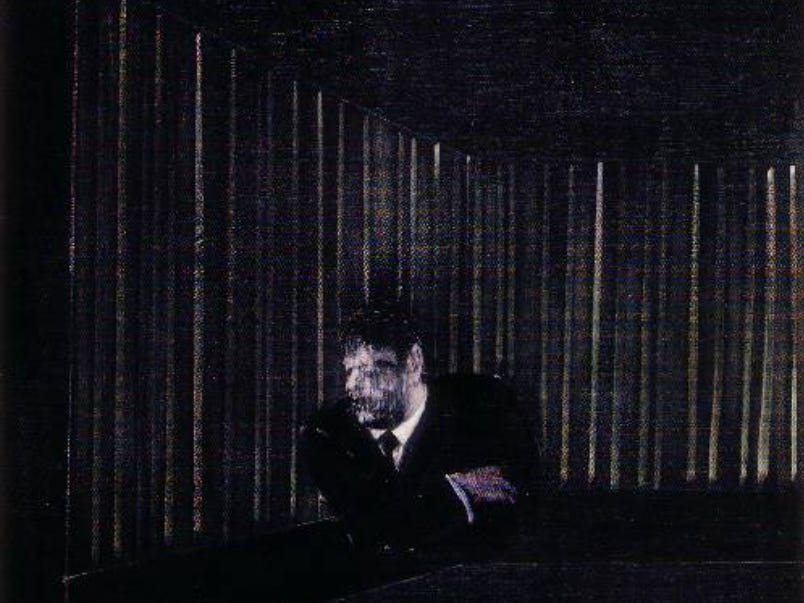
I’ve been thinking lately about the space between our ears. Our relationship to that mind-body space shapes how we experience life’s inevitable hard things.
Say you’re dealing with a problem. For simplicity, let’s imagine the problem occupies a cube that’s 8×8×8.
When you are fixated on the problem, when you are ruminating about it, when you are identified with the part of you that holds this problem, something very specific is happening: your entire mental space becomes 8×8×8. The problem and the container for the problem are now the same size. That’s what identification means. You are not with the problem. You are the problem.
From inside that cube, the problem feels total. If you pay careful attention, you can feel this not just cognitively, as a narrowing of focus and attention, but also somatically. Muscles clench. Fascia tightens. Breath becomes shallow. Mind and body constrict together (because, surprise, they were never actually separate). This is why identification feels so overwhelming. It’s not just ‘in your head,’ not just metaphorical. Contracted mental space is also, literally, contracted physical space. And from this contracted position, our instinct is often to push the problem away. But when you and the problem occupy the same space, there’s nowhere for that force to go. It’s exertion without movement—which means exhaustion.
What contracts can expand
Over the past few thousand years, resourceful humans have developed many reliably repeatable ways to access expanded mental space: meditation, parts work, psychedelics, music, bodywork, breathwork, and countless others. What these seemingly disparate practices all reveal is that mental space isn’t fixed at all. It’s actually boundless—though don’t take my word for it, run the experiment yourself.
What we find when we do run any of these experiments is that our problems haven't changed. They’re the same size. But now they exist inside something vast. And so proportionally, they feel small. Not irrelevant or dismissed. Just no longer total. What a relief! And what freedom. If the container can always expand, we don’t need the problem to go away or to try and control every external situation. That’s good news because it turns out that trying to control reality doesn’t work. We just need more room.
While meditation is probably the most well-known path to access this expanded space, I want to focus on two others in particular—parts work and bodywork—because in my experience they’re fast and reliable ways for beginners to become more spacious.
The conversational path
Conversational parts work offers a rich entry point to spatial expansion because the moment you recognize “a part of me feels anxious,” you’ve already created more room. Why? Because now there are at least two things present: the part, and whatever is noticing the part. The container must then be larger than any single part it holds.
As you recognize more parts, the internal architecture grows more complex and spacious. The psyche becomes less like a sealed box and more like a landscape. But the real expansion happens when you stay with a part long enough to drop from the depth of Parts—organized around subjects and objects—into the depth of Process, the flow of felt sensation and emotion.
If you stay with that flow, you can drop into Presence itself—the spacious awareness that holds all movement and content. Here you’re resting as the landscape, rather than the objects that dot it (parts) or the weather that moves through it (process).
We go from being identified with the part to recognizing ourselves as the space that holds it.
The somatic path
Remember: contracted mental space is contracted physical space—so we can approach it from either side. Open physical space, and mental space opens with it.
This is why bodywork can offer such a direct route to expansion. When we meet patterns of chronic tension that hold unprocessed emotion in the body—what neo-Reichian traditions call character armor—we’re still working with parts, but through touch rather than conversation. The armor is the exterior of the part. By being with it, by helping it feel seen and safe through presence and physical contact, we invite it to release.
As it does, we move straight into process space, accessing the same weather of experience that conversational parts work reaches through dialogue. From there, we can sink even deeper into Presence.
What’s remarkable is that bodywork can accomplish the same thing as meditation or conversational work—perspective, relief, and access to our innate resourcefulness—without any “mental” activity at all. No sitting practice. No talking through the story. Just presence and touch. The body releases, space opens, and suddenly that 8×8×8 problem feels workable again.
Getting perspective
Everyday language sometimes reveals something deeply true about the nature of reality. Consider how we say we need to “get perspective” on something, a phrase that perfectly captures the spatial metaphor we’ve been exploring.
When your mental space and your problem are the same size, when you’re trapped in that 8×8×8 cube, you have exactly one angle. You’re pressed up against the problem with nowhere else to stand. In this situation, it’s no surprise that we feel stuck. But when space opens, something new becomes possible. You can walk around the problem. See it from the side. From behind. From above. Having room doesn’t guarantee you’ll take that walk, but it means you can. That question—what else is here? what does this look like from over there?—becomes available. This is where creativity and resourcefulness come from: not from trying really hard or minimizing the problem, but from gaining perspective, from making the space bigger.
And Presence, whether you arrive there through meditation, conversation, or touch, is the biggest space there is. Ultimately it’s boundless. With continued practice, this expanded space becomes more stable and more accessible. We feel more spacious in our daily lives. Life feels easier, not because our problems disappear, but because we are no longer identified with them.
If you'd like support making space, I offer one-on-one coaching. To learn more or schedule a free discovery call, visit my website or contact me at contact@jeremyfisher.world.